




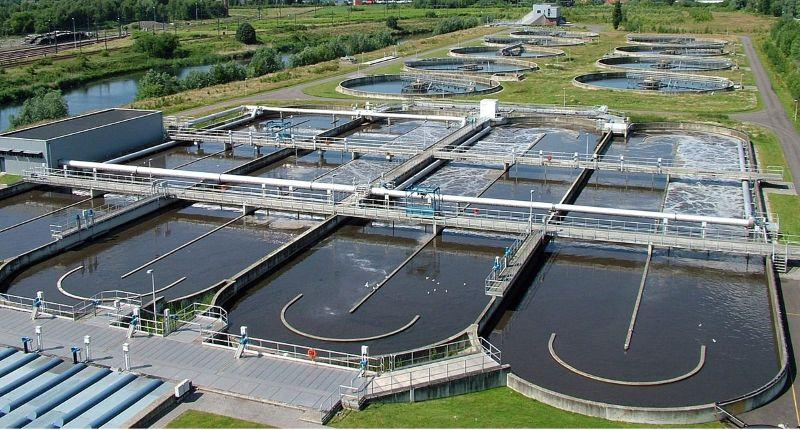
Activated sludge process (ASP) - biological treatment for wastewater

By Community in Environmental engineering
· 18 views
What is activated sludge?
It is a FLOC (i.e. body of micro-organisms gathered in a crowd) produced in a raw or settled sewage by the growth of bacteria and other organisms in the presence of dissolved oxygen and accumulated in sufficient concentrations by returning floc previously formed.
Activated sludge process
Activated Sludge Process is the biological method for treatment of wastewater. It was devised by Arden and Lockett in 1914. In this process a mixture of sewage and activated sludge is agitated and aerated in an Aeration Tank. Bacteria present in the activated sludge aerobically metabolize the organic matter present in the influent. The organic matter is oxidized to CO2, H2O, NH3 etc. and a portion of it is converted into new bacterial cells.
The activated sludge is subsequently separated from the Mixed Liquor (mixture of sewage and activated sludge in the aeration tank) by sedimentation in the Final clarifier and wasted or returned to the aeration tank as needed. The treated effluent overflows the final clarifier.
Sludge settleability
The degree of treatment in ASP depends upon the settleability of sludge in the final clarifier. The biological floc settles by gravity and leaves a clear supernatant for disposal. However, if filamentous micro-organisms grow in the aeration tank, they do not separate by gravity and contribute to BOD and Suspended Solids in the effluent. Excessive carry over of FLOC, resulting in the inefficient operation of final clarifier is referred to as Sludge Bulking.
Conditions promoting growth of filamentous micro-organisms
Insufficient Aeration - Dissolved Oxygen (DO) Level
Lack of Nutrients -Nitrogen (N), Phosphorous (P)
Presence of toxic substances
Low pH - Promotes fungal growth
Over Loading i.e. High Food: Micro-Organisms (F:M) Ratio
F:M ratio
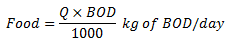
F:M ratio is expressed in terms of kg of BOD applied per day per kg of MLSS. If Q is the sewage flow in cu meter per day and it has a BOD expressed in mg per liter then:
If V is the volume of aeration tank in cu meter and it has MLSS concentration expressed in mg per liter then:
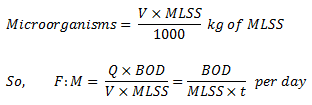
Where t is the Aeration Time in days
Sludge volume index (SVI)
SVI Indicates sludge settling characteristics. It is the volume in ml occupied by one gram of settled suspended solids.
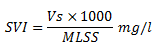
An SVI from 50 to 150 indicates good settling characteristics.
Advantages of ASP | Disadvantages of ASP |
|---|---|
High BOD removals (greater than 95%) | Extremely sensitive and sophisticated |
Low land areas required | Skilled operation is needed |
Odor free operation | Sludge bulking problem |
Treats industrial wastewater well | High operating costs |
Recommended Comments